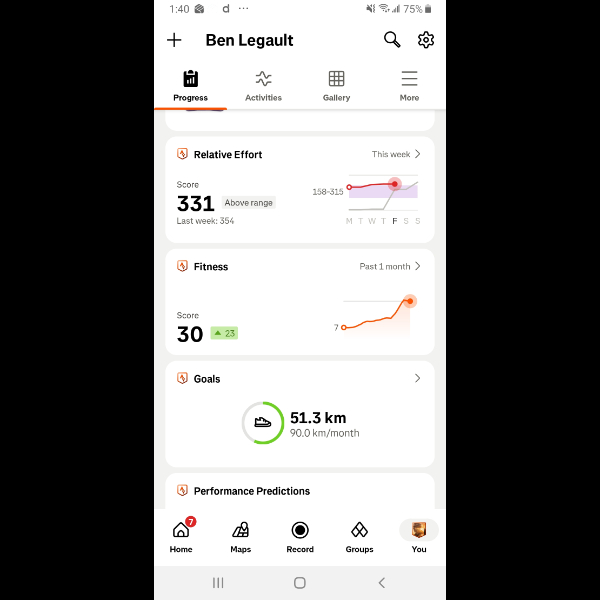
My Activity Tracking
94
kms
My target 90 kms
🌟 I need your support! 🌟
This September I'm walking and fundraising for Heart & Stroke, and I can’t do it alone. Every donation, big or small, brings me one step closer to my fundraising target.
Will you join me in making a difference? 🙌
Together, we can make every beat count! 💪
My Achievements
First Donation Received
50% Reached Target

Received 5 Donations
Reached Fundraising Target
Uploaded Profile Picture
Reached Fitness Target
My Updates
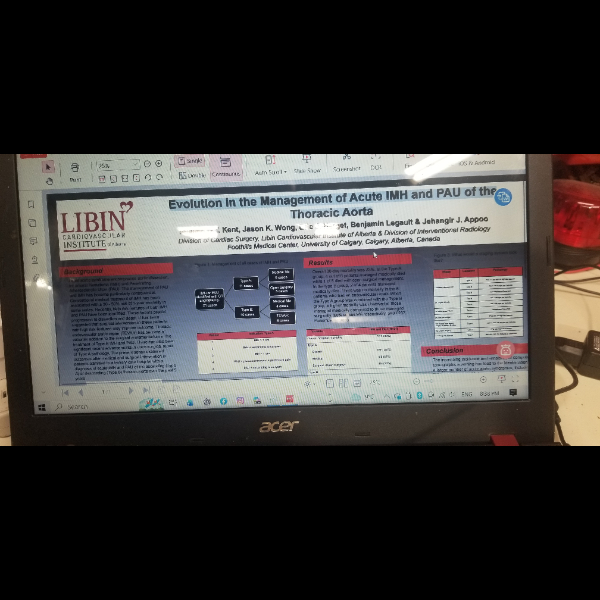
Beyond the Survivor: Part 5; Nerd Alert - The Research
Tuesday 15th Sep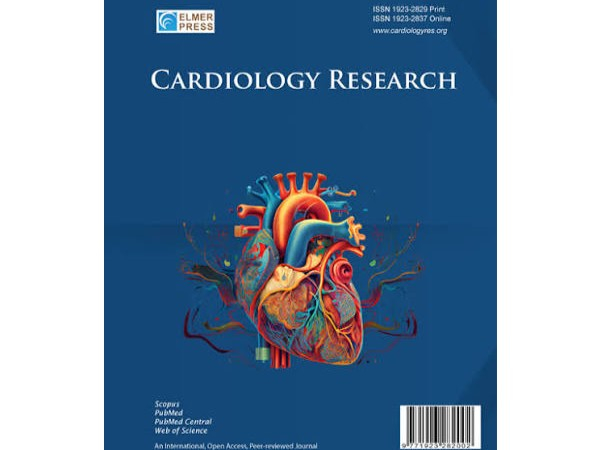
Beyond The Survivor — Part 5
Nerd Alert — The Research
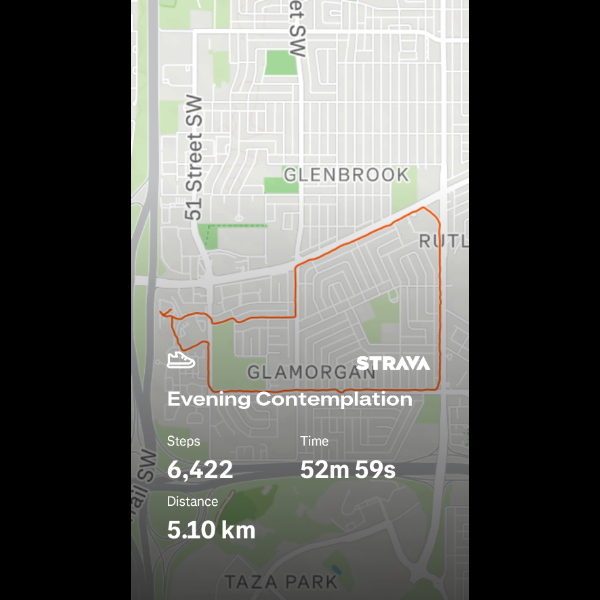
92km
Well…
My watch started making all kinds of noises, alerting me that I had reached the challenge goal. You'd think I would be relieved, and yet I'm not fully satisfied…
More on that later in the blog.
For now, let's nerd it up.
Your generous donated dollars and the RESEARCH.
If you've read my previous blogs, this probably won't come as a surprise.
I'm a nerd.
More specifically, I'm the kind of nerd who can disappear down a medical research rabbit hole for hours because I saw one interesting study and thought:
“Well, I wonder what they found?”
So when I started this challenge, one of the things I wanted to understand was something I've mentioned throughout this series:
Where does the money actually go?
We've talked about survivors.
We've talked about partners and caregivers.
We've talked about children.
We've talked about the resources that can help families after a heart or brain health event.
But what about the research?
What are scientists actually doing with the support that organizations like Heart & Stroke provide?
Well…
Now we get to the fun part.
Research isn't just about finding a cure
When we hear the word research, I think it's easy to imagine somebody in a laboratory wearing a white coat, staring into a microscope and waiting for something interesting to happen.
And yes, sometimes there probably is a microscope involved.
But cardiovascular and stroke research is much bigger than that.
Researchers are trying to understand how disease develops, how we can identify risk earlier, how we can treat a heart attack or stroke more effectively, how we can reduce disability, and how we can help people recover afterward.
Sometimes they're trying to answer questions that seem incredibly specific.
Sometimes they're trying to answer questions that could change an entire field of medicine.
And sometimes they're simply asking:
“What if?”
That's where things get interesting.
What if we could remove the clot?
Let's start here because this is a Canadian—and particularly an Alberta—research story.
In Calgary, researchers including Dr. Michael Hill, Dr. Andrew Demchuk and Dr. Mayank Goyal led the ESCAPE clinical trial. (1)
The research looked at endovascular treatment, or EVT, for severe ischemic strokes caused by large blood clots blocking major arteries in the brain.
The concept sounds almost like science fiction when you stop and think about it.
Instead of simply trying to dissolve the clot with medication, doctors can guide a catheter through the body's blood vessels to the blockage in the brain and physically remove it.
The ESCAPE trial showed that this treatment could cut deaths from these severe strokes by about half while substantially reducing disability.
That research helped change stroke treatment around the world.
And this is where the research nerd in me gets excited.
Because that wasn't magic.
Somebody had to ask the question.
Somebody had to design the study.
Somebody had to recruit patients.
Somebody had to collect the data.
Somebody had to analyze it.
And then other researchers had to test, challenge and confirm the findings.
Eventually, something that started as a research question became a treatment that can give someone another chance at life.
That's the journey from “What if?” to “Let's try it.”
And eventually to:
“We know this works.”
What if we could identify the risk before the heart attack?
Here's another one that caught my attention.
Dr. Guillaume Paré and his research team are looking at the genetic factors that can contribute to very early heart disease.(2)
Rather than looking for one single genetic switch that says, “You're going to have a heart attack,” researchers are looking at huge numbers of genetic variations and how their combined effects may influence someone's risk.
This is where things get wonderfully complicated.
Our genetics don't come with a little warning label saying:
“CAUTION: HEART ATTACK RISK.”
Wouldn't that be convenient?
Instead, researchers are trying to understand patterns buried within millions of pieces of genetic information.
The goal is to eventually become better at identifying people who may be at increased risk—potentially decades before a cardiovascular event occurs.
Think about what that could mean.
Instead of meeting someone after their heart attack and saying:
“Here's what happened. Now let's treat it.”
Imagine being able to identify elevated risk earlier and say:
“Here's what we found. Let's see what we can do before something happens.”
That's a completely different approach.
And it's one of the reasons I think research matters so much.
Because sometimes the best treatment isn't a better treatment for the disaster.
Sometimes it's preventing the disaster from happening in the first place.
What if the heart could repair itself?
Now we're getting into territory that really makes my inner nerd happy.
Heart & Stroke-funded researcher Dr. Kim Connelly and his colleagues are investigating ways to repair heart cells damaged by heart attacks and other forms of heart disease.(3)
Their work has moved from laboratory research toward clinical research looking at whether damaged heart tissue can actually be helped to recover.
For someone like me, that's a pretty fascinating question.
Because once heart muscle has been damaged, we've traditionally had very limited ways of reversing that damage.
So researchers are asking:
Can we change that?
Can damaged heart cells be repaired?
Can heart function be improved?
Can we prevent the progression toward heart failure?
These aren't questions with simple answers.
And that's exactly why we need researchers willing to spend years trying to answer them.
And the research doesn't stop there
This isn't research that happened twenty or thirty years ago and then got put on a shelf.
It's happening right now.
In 2026, Heart & Stroke, Brain Canada and the Canadian Institutes of Health Research announced a $5-million, five-year initiative focused on cardiac arrest research. (3)
The funded teams are working on three major areas:
Prediction and early detection.
Improving response and survival.
And optimizing brain recovery after cardiac arrest.
That's an entire research program built around questions that could affect whether someone survives a cardiac arrest, how well they recover, and what life looks like afterward.
And just recently, another $5-million, five-year research network was announced to focus on improving rehabilitation and recovery for women following heart-brain health events such as stroke, heart attack and cardiac arrest.
So when someone says:
“My donation goes toward research.”
That doesn't mean the money disappears into some mysterious scientific black hole.
It means researchers are being given the resources to ask questions that don't yet have answers.
Here's the uncomfortable part about research
Not every experiment works.
Not every theory is correct.
Not every promising treatment becomes a treatment.
Sometimes researchers spend years following an idea only to discover that it doesn't work.
And that's not failure in the way we normally think about failure.
Sometimes finding out that something doesn't work is exactly how science moves forward.
Because you can't discover the right answer without being willing to test the wrong ones.
That's one of the things I love about research.
It doesn't pretend to already know the answer.
It asks the question.
Then it tests it.
Then it tests it again.
And sometimes somebody eventually finds something that changes everything.
So what did your donation help fund?
This is where I want to bring the whole series back around.
We've spent the last few blogs looking at what happens after someone becomes a survivor.
The partner.
The caregiver.
The children.
The friends.
The family.
The community.
But research allows us to look in the other direction.
Before.
Before the heart attack.
Before the stroke.
Before the cardiac arrest.
Before another family has to learn what aphasia means.
Before another child has to wonder why Mom or Dad suddenly can't do the things they used to do.
Before another partner has to become a caregiver overnight.
Research is trying to move the starting line.
Earlier detection.
Better prevention.
Faster treatment.
Better recovery.
Less disability.
More lives saved.
More time with the people we love.
And that's why I walked.
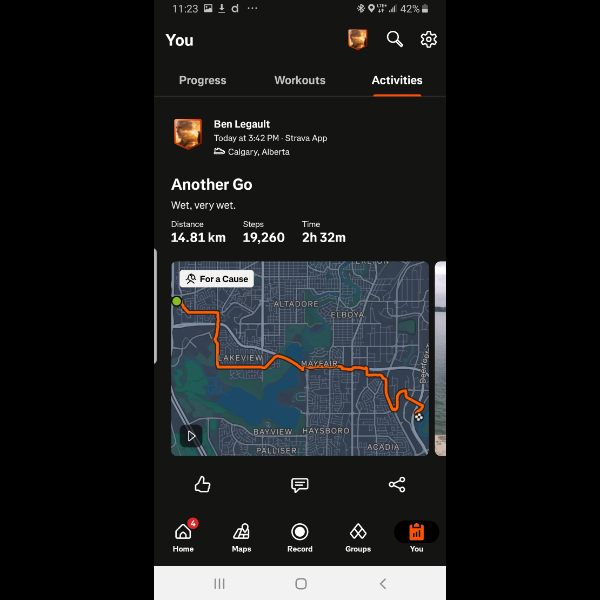
I started this challenge with a goal of 90 kilometres.
I've now walked 92km
And apparently I'm not finished yet.
The dollars you donated don't simply end when a project reaches its goal or a study is completed.
Research builds on research.
Today's discoveries become tomorrow's starting point.
One question leads to another.
One study gives another researcher something to work with.
One breakthrough can open an entirely new area of investigation.
And that is how science moves forward.
So, as happy as I may be that I saw my watch go:
“Yay! You reached 90 km!”
I'm just not content.
The kilometres became a way of telling a much bigger story.
I started by telling you why I walk.
Then we looked beyond the survivor.
We talked about the partner.
The children.
The wider circle.
We followed the money trail.
And now we've followed it into the laboratory.
Into the research centres.
Into the clinical trials.
Into the questions that researchers are still trying to answer.
And maybe that's the most important thing I can leave you with.
I'm not walking only for the answers we've already found.
I'm walking for the questions we haven't answered yet.
What if we can prevent it?
What if we can detect it earlier?
What if we can treat it faster?
What if we can repair the damage?
What if we can give someone another twenty years?
Another ten?
Another birthday?
Another Christmas?
Another walk?
Another chance to watch their kid graduate?
Another chance to walk their daughter down the aisle?
Another chance to simply wake up tomorrow?
Those are the things research can eventually make possible.
But somebody has to ask the question first.
Somebody has to fund the research.
Somebody has to be willing to say:
“We don't know yet. Let's find out.”
That's what your donations can help make possible.
And that's something worth walking for.
92 kilometres down.
And for September,
I'm still walking.
For my heart.
For Mike.
For the survivors.
For their families.
And for all the questions we haven't answered yet.
Let's see what science can do.
And before I sign off my series blog, I want to thank everyone who donated—not only your hard-earned money to a cause close to my heart, but also your time.
Thank you to everyone who took time out of your busy schedules to read my blogs and follow my progress.
It is the kindness and generosity of all of you that helps support the work being done to advance cardiovascular and stroke research.
My heart truly thanks you.
And if Mike were here, I know he would thank you too.
Thank you again for following along.
Enjoy the rest of September, and maybe check back later to see how many more kilometres I manage to log.
(1)
“CSM: Escape Stroke.” Cumming School of Medicine, 16 Feb. 2023, cumming.ucalgary.ca/escape-stroke. Accessed 15 Sept. 2026.
Thériault, S., Lali, R., Chong, M., Velianou, J., Natarajan, M. and Paré, G.
Thériault, Sébastien, et al. Circulation: Genomic and Precision Medicine, vol. 11, no. 1, Jan. 2018, doi:10.1161/circgen.117.001849.
“Leading Canadian Researchers Awarded $5M to Advance Cardiac Arrest Prediction, Survival and Recovery.” Heart and Stroke Foundation of Canada, 22 June 2026, www.heartandstroke.ca/what-we-do/media-centre/news-releases/leading-canadian-researchers-awarded-5m-to-advance-cardiac-arrest-research?utm_source=copilot.com. Accessed 15 Sept. 2026.
Share
Beyond the Survivor part 4: follow the money Trail
Tuesday 8th Sep
The first steps
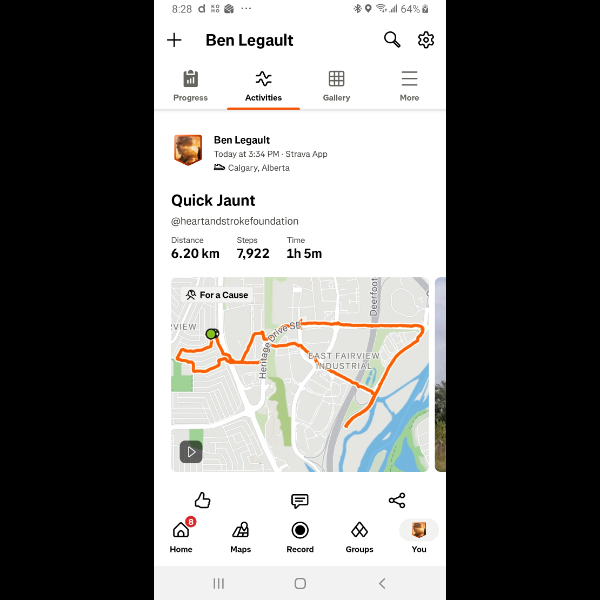
Saturday 5th Sep Check out a 3D Flyover of my first official September 90km for the Heart and Stroke Foundation challenge. To view, click on the link below while figure out why i.can not upload it to my activity feed.
Beyond The Survivor Part 3: The Social Circle
Thursday 3rd SepHappy September, Readers — Let the Walking Begin
As we close out summer and walk quickly into what already feels like fall, let’s take a look at the last weight of surviving a stroke.
So far, we’ve looked at the primary caregiver—the spouse, the partner, the lover, if you will. Then we looked at the kids and how quickly life can change for them.
Now, we look at the social circle shift: why friends pull away.
One of the most painful aspects of post-stroke life can be watching the family’s social circle shrink. It’s easy to assume friends don’t care, but the reality is usually much more nuanced.
Most friends pull away not out of coldness, but because of awkwardness, discomfort, and a fear of doing or saying the wrong thing.
Misunderstanding the Side Effects
Post-stroke challenges like speech difficulties, emotional lability—sudden, uncontrollable laughing or crying—or fatigue can make social interactions feel unpredictable.
Friends who don’t understand these symptoms may retreat simply because they don’t know how to act or what to say.
The Fear of Being a Burden
Friends may feel that visiting places extra strain on an already exhausted family. Sometimes, rather than risk intruding or becoming another responsibility, they stay away entirely.
The Isolation Gap
As invitations dry up, both the stroke survivor and their family can end up feeling deeply isolated at exactly the time they need community the most.
It’s okay to talk to the people you allow into your inner circle. Be honest. Chances are, they are just as nervous about saying the wrong thing as you are.
Educate your friends.
Sometimes, a short and honest text to a close friend explaining what to expect can break the ice and ease the awkwardness:
“John loves visitors, but he gets tired quickly and speaks slowly now. Just sitting with him for 20 minutes means the world.”
Sometimes, it really can be that simple.
These are just three of the more nuanced struggles that can exist after a stroke or a heart disease diagnosis—struggles that extend far beyond the person who received the diagnosis.
It’s chaos. It’s love. It’s life.
Finding a “New Normal” Together
Navigating life after a stroke is not a sprint. It’s a marathon without a fixed finish line.
While the challenges can be profound, finding a path forward is possible with time, patience, and support.
Acknowledge the Grief:
It is entirely valid for spouses and children to grieve the life they had before the stroke. Validating those feelings, rather than burying them, is crucial.
Reassure the Kids:
Explicitly relieve children of the burden of medical responsibility. Remind them that they are kids first, caregivers second, and that another stroke is never their fault or their responsibility to prevent.
Seek Support Outside the Home:
Joining a caregiver support group or family counselling can provide a safe space to vent, learn strategies from others who “get it,” and help combat isolation.
Final Thought
As I push my first steps toward that 90 km finish line, this is what I want to leave you with:
Recovery after a stroke isn’t just about the survivor learning to walk or talk again.
It’s about a family re-learning how to function, communicate, and love each other through a profound life transition.
Grace, flexibility, and seeking help along the way aren’t just helpful—they’re essential.
So don’t be scared to ask:
How do the funds raised for the Heart and Stroke Foundation help those beyond the survivor or patient diagnosed with heart disease?
Why, excellent question.
Join me in my next blog series (Title TBA) after I’ve put some steps toward raising these funds, and I’ll share just how far your pledge money goes.
You might be surprised at just how much further those pennies go.
And now…
Okay. Hill one. Oh boy. Let’s do this.
Share
Beyond the Survivor: Part 2; The Children's Story
Wednesday 26th Aug
As August draws to a close and I prepare to launch my 90km Challenge on September 1st—raising critical funds and awareness for the Heart and Stroke Foundation—I’m honored to share part two of our Beyond the Survivor series. I am also honored to say "thank you" to my anonymous first donor for your support; whoever you may be, thank you.
While the first installment focused on the immediate physical and emotional toll a stroke or heart disease diagnosis takes on a survivor and their primary caregiver, this chapter turns toward a group whose voices often go unheard in the immediate aftermath: the children.
When a parent faces a major medical crisis, a child's entire world shifts overnight. They may not always have the words to express their fear, confusion, or grief, but they carry the heavy emotional weight of that diagnosis right alongside us.
Children process a parent’s stroke in complex ways, depending on their age.
The person they relied on for protection and guidance may suddenly look, speak, or act entirely different. Learning a new language of connection if a stroke results in aphasia (difficulty speaking or understanding speech) or changes in personality/mood. The loss of easy conversations can leave children feeling confused or isolated and lead to a need to learn new ways to interact with their parent.
The Weight of the 'What If' is often a heavy struggle for children. When kids are asked to help out—whether that's watching their parent while mom or dad runs an errand or helping with basic needs—a heavy fear often settles in.
They worry: “What if another stroke happens on my watch? Will I know what to do? Is it my fault if something goes wrong?”
Children often take on adult responsibilities earlier than expected, balancing their school and social lives with the emotional weight of a fragile home environment.
FINAL THOUGHTS:
Navigating life after a stroke is not a sprint; it’s a marathon without a fixed finish line. While the challenges are profound, finding a path forward is possible with time, patience, and support.
Acknowledge the grief: It is entirely valid for spouses and children to grieve the life they had before the stroke or diagnosis of heart disease. Validating those feelings—rather than burying them—is crucial for mental health.
Reassure the Kids by explicitly relieving children of the burden of medical responsibility. Remind them that they are kids first, caregivers second, and that another stroke is never their fault or responsibility to prevent.
Seek support outside the home. Joining a caregiver support group or family counseling can provide a safe space to vent, learn strategies from others who "get it," and combat isolation.
Recovery after a stroke isn't just about the survivor learning to walk or talk again. It’s about a family re-learning how to function, communicate, and love each other through a profound life transition.
Grace, flexibility, and seeking help along the way aren't just helpful—they are essential.
Share
Beyond the Survivor: Why The People Around a Survivor Matter Too:
Monday 17th Aug
While I've been tweaking my profile page and deciding what these blogs should embrace beyond my personal progress during September and the 90 kilometres I'm walking, I kept circling back to the same theme.
When we think of the Heart & Stroke Foundation, we often think first of the survivor: the person who suffered a stroke or the individual living with heart disease. And rightly so. Their survival, recovery and health are at the centre of everything.
But there is another part of the story that can be easy to overlook: the people who love them.
A stroke or serious heart condition doesn't affect only the person whose name is on the medical chart. In an instant, it can change the lives, routines, responsibilities and expectations of an entire family.
So while I walk my 90 kilometres and share my progress for those who have donated and followed along, I want to use this series to look beyond my own story. I'll also be sharing some of the ways funds raised through the Heart & Stroke Foundation can help people affected by cardiovascular disease and stroke—including the people standing beside the survivor.
The Partner's Shift
When a stroke happens, the immediate focus is rightly on survival and medical recovery. We measure progress in physical therapy milestones, speech improvements and doctor visits.
But for a spouse or partner, life can change just as suddenly.
The person who was your partner may now need help with things that used to be routine. A partner can suddenly find themselves managing medications, appointments, therapy sessions, mobility, household responsibilities and finances—while also trying to be there emotionally for the person they love.
The shift from partner to caregiver can happen almost overnight.
And that creates a complicated mix of emotions. There can be love, determination and hope, but there can also be exhaustion, fear, frustration and grief for the life that existed before the stroke.
It can be heartbreaking to watch someone you love struggle with tasks that used to be second nature. It can also be incredibly difficult for the caregiver to admit that they are struggling themselves when everyone is looking to them to be the strong one.
Caregiving isn't simply about doing more tasks. It's also about mourning the life you had while trying to build a new one together.
That is something I think deserves more attention.
Because when we talk about recovery, the survivor is obviously an enormous part of the conversation. But recovery doesn't happen in isolation. Families have to adapt too. Partners have to adapt. The definition of what “normal” means can change for everyone in the household.
And that is where I want to take this series.
This is only the first look beyond the survivor. In the next posts, I'll look at what happens to the children of a survivor, then at the friends and wider social circle that can also be affected. I'll also connect those stories back to the practical ways donations to the Heart & Stroke Foundation can support people living through those changes.
Because the person who survives a stroke or lives with heart disease may be the one carrying the diagnosis, but they aren't necessarily carrying it alone.
And neither should the people who love them.
Share

I love your beautiful heart Ben!